
Our Story: We are Maleku Territory
AFELA i Ú is found within the indigenous Maleku territory, home of the mythical “Afela”, the Great Green Macaw. Our name is a tribute to this magnificent bird that has graced our lands for generations, painting the blue sky with its vibrant green feathers and feeding on our Jabillo and Mountain Almond trees.
Mission
Our mission is to offer an ethical tourism opportunity that unites education, conservation, and our Indigenous Maleku culture. We utilize traditional practices alongside native species and regenerative materials to advance the self-sufficiency of the Maleku tribe, increase our mutual respect with the natural world, and educate the global community.
Vision
We aim to be a permaculture center that applies best practices, oriented towards the self-sufficiency and sustainability of our natural and cultural resources. We believe that every living being who visits us should be treated with respect. Animals are a fundamental part of our lives—as pollinators, seed spreaders, and biological pest controllers.
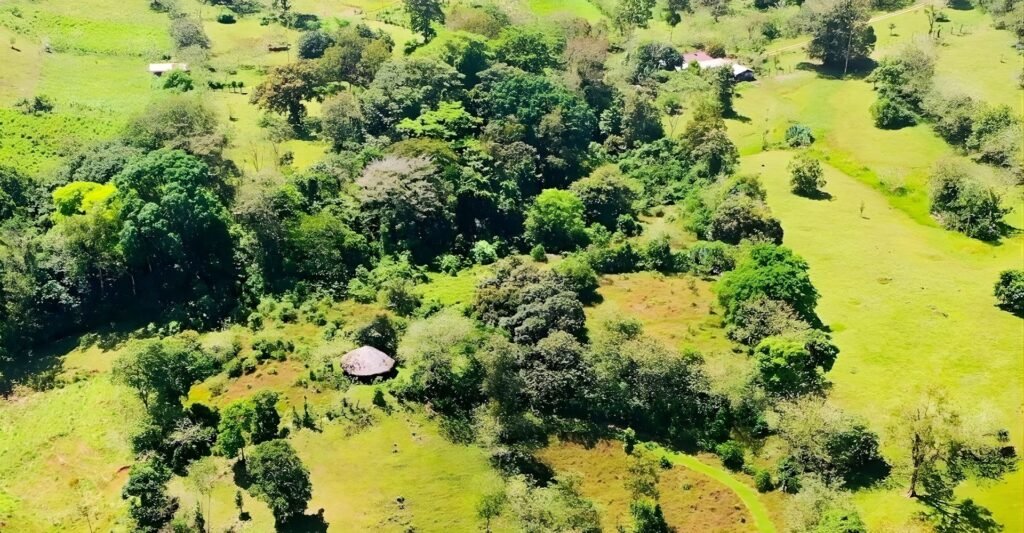
We are part of the small biological corridor of Palenque Tonjibe
A Maleku territory with a community of approximately 250 people. We seek to create a network with our neighbors, one that provides for everyone involved for the good of the community and the environment.
A Brief History of the Maleku People in Guatuso
Historical Territory: Their original territory was much larger than the current one, encompassing a significant portion of the Río Frío basin, and sacred sites such as the Rincón de la Vieja volcano, Río Celeste, and the Arenal Volcano.
Origins and Culture: According to their worldview, their main god, Tócu, created them from cocoa seeds. Their culture is deeply linked to nature, which they consider sacred. Traditionally, they were hunters, farmers, and excellent connoisseurs of medicinal plants.
Demographic Collapse and Conflicts: In the mid-19th century, the Maleku population was estimated to be between 1,500 and 2,000 people. However, their population collapsed later that century, mainly due to violent conflicts with Nicaraguan rubber tappers who encroached on the area for wild rubber extraction. A key event was the bloody battle on the River of Death (Río de la Muerte) in 1868.
Current Location: Today, most of the Maleku people live in the Maleku Indigenous Reserve (established in 1977) in the canton of San Rafael de Guatuso, Alajuela province. They are distributed across three main communities or settlements (palenques): Margarita, Tonjibe, and El Sol.
Cultural Resilience: Despite the reduction of their territory and population, the Maleku people have shown great resilience. They have preserved their language, Maleku Jaika (classified as endangered), which is taught in schools and used in daily and ceremonial life. Their current economic activities focus on agriculture, crafting traditional goods, and Indigenous ecotourism as a way to preserve and share their culture.